
Childhood Dreams
Summoning Gratitude and Avoiding Unforced Errors

Last time I shared a question you can ask to make someone feel good. Today, I’ve got another that has been useful.
Memory
I place zero credibility on my ability to accurately recall anything, even recent stuff. I explained why in Part Two of my Thinking Better Series.
That said, just because memory is unreliable (as a statement of fact) doesn’t mean it isn’t helpful for gaining self-awareness.
It’s precisely because memory is selective, changeable and self-serving that it provides insight to motivations driving our choices and desires.
With a good system for enhancing memory, we have an opportunity to see how we change, skew and forget the past.
The Child Who Lives On
The best take on childhood dreams is Randy’s. There’s a book that goes with the video. I’ve saved the book for my adult kids. It’s how I’ve tried to live my life. They will find it when they go through my stuff.
Question of the Day
With that out of the way…
Tell me about your childhood dreams.
When I ask the question, it is not because I think memory is accurate. It is an exercise in figuring out deep motivations.
Is the past taking us where we want to go?
A Practice To Build Energy
At the start of May, for 14 days, I dropped my life stress as low as I can manage. My close friends reading this will get a chuckle. Even when my stress is “high” it’s a fraction of what most of them deal with, daily. I deliberately keep a lot of empty space in my life.
Notionally, my mid-year break was for endurance training. When I started to rest, I got mildly sick. You’d be surprised how common this is for athletes. You (finally) give yourself permission to rest and all the fatigue comes pouring out.
Everyone in my house (except my wife) was sick at the time. In April, I was exposed to whooping cough, pneumonia, four airports and a continuous stream of nonspecific upper respiratory infections. That said, it’s never bad luck. Mild sickness during a break is no-big-deal. It was strangely convenient as I wasn’t tempted to skip my recovery block.
One of the benefits of low training stress is my creativity shoots up. I took advantage of the energy boost to write a ton, and ask myself the questions I’ve been sharing with you.
Like Randy (above), I realized I’d managed to achieve my childhood dreams, with a couple twists.
What does my memory tell me about the challenging parts of my childhood?
I remember being not-athletic, surrounded by conflict and not popular. Sounds a little brutal.
At a surface level, I tell people it was fine, and I’m glad the way things turned.
At a deeper level, I don’t have interest in reinforcing any negative thoughts.
Day-to-day, I leave those thoughts and reset back to taking action.
During my mid-year break, I realized my perceived past is the polar opposite of my present. At the same time as my realization, tremendous feelings of gratitude welled up. You can feel Randy experiencing the same thing in his video (above). It’s a powerful technique for building mental energy and resolve.
Pay attention to any sequence the reliably generates feelings of gratitude. Gratitude is an antidote to just about anything we will face.
He is, the most effective man I know
This technique, of observing a negative then framing to generate gratitude, was taught to me by someone who works with strong personalities.
It started by asking him how he deals with a$$holes. He said he focuses on how grateful he is that he has a choice to “not be that guy.”
That’s his gratitude technique.
Immediately when he feels a bit of tension, he shifts his mindset to gratitude that he has a choice to be a good guy. In reality, we always have a choice but it’s close to impossible to act that way when we trip into an automatic / defensive / judging mindset. His flip into gratitude buys him time.
It’s an application of the Victor Frankl quote, “Between stimulus and response there is a space. In that space is our power to choose our response. In our response lies our growth and our freedom.”
Bit more about my friend. He never takes life personally, steers clear of taking political sides and is able to work with radically different people. He’s firm, fair and effective.
My buddies, who have risen to the top of their fields mirror his profile. My friend is not Naval, but you can find a lot of his approach in the Navalmanack. The whole book (previous link is to Amazon) is available free here. I bought the paper version because my retention is better reading paper than screens. I also wanted to leave it as a bread crumb for my kids. Poor Charlie’s Almanack is beside it on my bookshelf.
The Navalmanack has a section on happiness. I’ve never heard my buddy talk about planning happiness. He’s too busy getting stuff done. However, he is excellent at pausing from his busy life and enjoying the good times. It’s similar to the Paul Tudor Jones discussion of the role of struggle, meaning and wonder (bottom of last time’s post).
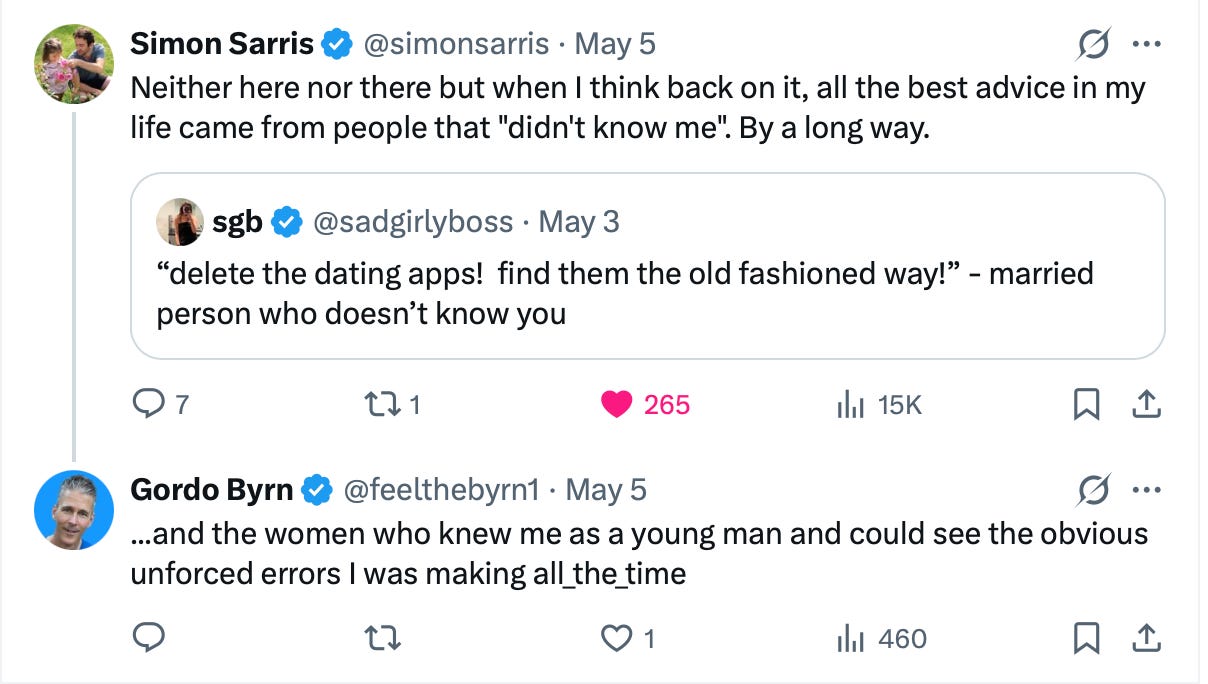
It’s worth discovering your gratitude triggers. You’ll save yourself a whole lot of hassle and unforced errors.
Said it before but it's worthy of repeating, True Wealth is some of your best work
:-)
Gold as always.
Gratitude and training are probably the most effective ways to reach inner peace and strength.